
What is a Heavyweight Hoodie?
As a clothing manufacturer, Yali Clothing has accumulated many years of experience in designing and producing heavyweight hoodies. These hoodies are not your average (style); they are made with thicker fabrics, typically with a weight of 300gsm or more, even reaching 400-500gsm. They feel heavy and substantial, making them perfect for staying warm in autumn and winter or for creating a durable streetwear look. Compared to lighter hoodies, heavyweight versions are on a completely different level in terms of texture and longevity. We made a batch of winter series for a client using high-weight cotton, and the client reported that it didn’t pill even after years of wear, and the return rate was super high. Below, we’ll discuss how Yali Clothing makes a great heavyweight hoodie, from fabric selection and manufacturing processes to dyeing.


Fabric Selection: The Soul of a Good Hoodie
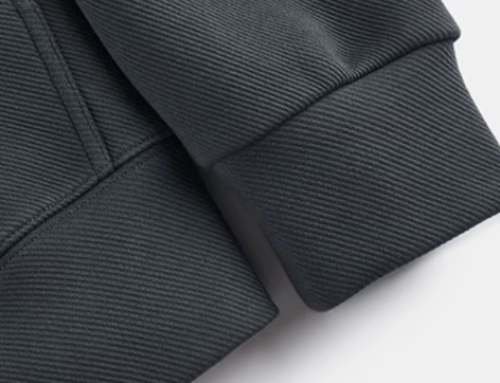
On Yali Clothing’s production line, fabric is always a top priority. Heavyweight hoodies need to use high-weight fabrics to maintain their shape and withstand the cold wind. The most common choice is all-cotton or cotton-polyester blends—pure cotton is soft, absorbent, breathable, and comfortable, but it may shrink; adding some polyester (such as 70% cotton + 30% polyester) can make the garment more durable and the shape more stable. We often use French Terry or Fleece with a weight of 350gsm or more, which doubles the warmth and is especially suitable for outdoor or sports scenarios.
When selecting fabrics, we pay special attention to yarn count and weave. Coarse yarn counts (20-30 count) in three-thread fleece or double-sided fabric can lock in heat and feel thick and structured. If the client’s budget is high, we recommend adding some wool or nylon blends to increase warmth, but the polyester ratio must be controlled below 50%, otherwise it is easy to feel stuffy and retain odors. Previously, a client complained about shrinkage with pure cotton(style), so we switched to pre-shrunk cotton material to solve the problem at the source. Nowadays, brands like us prefer high-weight cotton to ensure the garment is crisp and durable.
Manufacturing Process: From Fabric to Finished Product, Details Determine Success
Yali Clothing’s manufacturing process basically consists of yarn preparation, weaving, cutting, sewing, and accessory assembly, but because heavyweight hoodies use thicker fabrics, each step must be more refined. Weaving is done on circular knitting machines with high density, so the fabric surface is tight and does not sag. During cutting, we use lasers or CNC machines for precise cutting, especially for the “kangaroo pocket” and hood, to ensure symmetry, otherwise it will be awkward to wear. In the sewing stage, we use industrial flatbed sewing machines to reinforce the stitches, and the cuffs and hem are edged with rib knit fabric, which is elastic and prevents curling. The hood has a three-piece design with an inner lining for wind protection, and the drawstrings are made of cotton rope or metal buckles, which are strong and beautiful.
For small-batch customization, we make hand-made samples to adjust the fit to be close to the body; for large-scale production, we use assembly lines for high efficiency, but we never compromise on quality control. Once, when making a heavyweight series for a streetwear brand, the fabric was too thick and ordinary needles kept breaking, so we switched to thicker needles and added heat-setting to ensure no shrinkage. The finished product must pass a water wash test to confirm that it does not fade or deform. Compared to lighter styles, heavyweight hoodies take 20% more man-hours, but the durability is definitely worth it.
Dyeing Process: Making Colors Last and Eco-Friendly
In terms of dyeing, Yali Clothing focuses on balancing color and environmental protection. The dyeing of heavyweight hoodies is divided into yarn dyeing, piece dyeing, and garment dyeing, and the choice depends on the client’s needs. Yarn dyeing is the most stable, where the yarn is dyed before weaving, the color is uniform, and it does not fade even after 50 washes, suitable for high-end solid color styles, but the cost is high. Piece dyeing is dyeing the fabric in batches, the colors are bright, and thick fabrics require high-pressure dyeing vats, with the temperature controlled at 80-100°C to avoid color differences. Garment dyeing is flexible and suitable for gradients or special effects, but heavyweight fabrics are prone to uneven dyeing, so we add additives to ensure penetration. Nowadays, environmentally friendly dyes are a major trend, and we mostly use reactive dyes or plant dyes, which cause less pollution. Blended fabrics require a double bath method, direct dyes for cotton and disperse dyes for polyester, and high-temperature drying or steam setting to lock in color fastness after dyeing. Previously, we made a batch of dark-colored heavyweight hoodies using yarn dyeing process, and the client praised the color as new even after a year of washing.
Yali Clothing’s Small Advice: Why Choose a Heavyweight Hoodie, How to Choose
Heavyweight hoodies are not just for warmth; they are versatile, great for streetwear, wearing as a jacket, and they are durable and wear-resistant, one piece can last for years. When choosing, feel the thickness of the fabric, don’t consider thin ones; check if the stitching is neat; try it on and check the fit, oversize is popular, but don’t go so big that it loses shape. We at Yali Clothing consider these details when designing our heavyweight series.