
What is Twist Coefficient and How to Calculate It?
Twist coefficient is a relative value used to represent the degree of twisting in a yarn, taking into account both the twist per unit length and the yarn’s linear density. It allows for meaningful comparison of twist levels between yarns of different thicknesses.
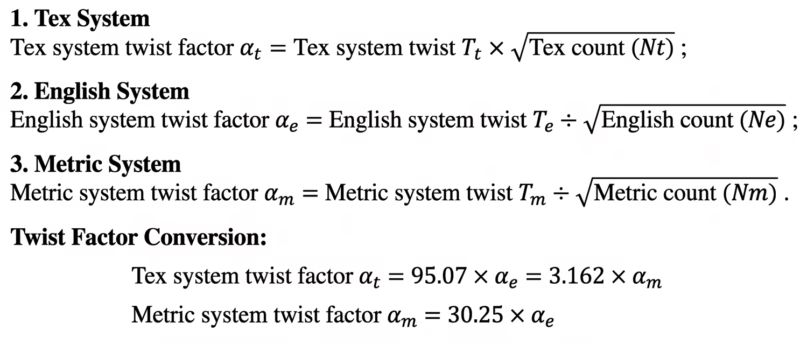
Twist per unit length alone cannot compare the twist level of yarns with different thicknesses, because for the same twist, a thicker yarn has fibers with a greater inclination angle than a finer yarn. In practical production, twist coefficient is commonly used to indicate the yarn’s twist degree.
Calculation of Twist Coefficient:
The twist coefficient can be calculated based on the yarn’s twist per unit length and its linear density. A higher twist coefficient indicates a higher degree of twisting.
Selection of Twist Coefficient:
- Determined primarily by raw material properties and intended yarn use.
- Yarn spun from fine and long fibers generally has a lower twist coefficient.
- Yarn spun from coarse or short fibers requires a higher twist coefficient.
- Warp yarns need higher strength, so a higher twist coefficient is required.
- Weft yarns and knitting yarns generally require softness, so a lower twist coefficient is preferred.
- Yarns used for woven or knitted pile fabrics should have a low twist coefficient to facilitate pile formation.
- For thin, crisp woven fabrics or knitted outerwear requiring a smooth, firm texture, the yarn twist coefficient should be higher.
- Finer yarns require a higher twist coefficient than coarser yarns.
- For general synthetic fibers, coarse yarns typically have a lower twist coefficient than cotton yarns. For cotton-type synthetic fibers, the twist coefficient is 50–60% of pure cotton; for medium-to-long synthetic fibers, it is 40–50%, depending on fiber type and yarn count.
Typical Twist Coefficients:
- Ring-spun weaving yarn: 360–400
- Ring-spun knitting yarn: 320–360
- Ring-spun low-count pile yarn: 280–320
- Air-jet spun yarn: 400–440
At Yaliapparel, we optimize the twist coefficient of yarns to achieve the perfect balance of strength, softness, and texture. Unlike simple twist counts, the twist coefficient accounts for yarn thickness, enabling precise control over fiber alignment and yarn cohesion.
- Optimized Strength and Durability:
By selecting the appropriate twist coefficient for warp yarns, fabrics achieve higher tensile strength and better dimensional stability, ensuring garments maintain their shape even after repeated wear and washing. - Balanced Softness and Comfort:
Weft and knitting yarns can be spun with a lower twist coefficient to enhance softness and flexibility, giving garments a pleasant hand feel and improved wearer comfort. - Enhanced Fabric Texture and Performance:
Adjusting the twist coefficient allows precise control over surface texture. Low-twist yarns facilitate pile formation for brushed or velvet-like fabrics, while higher-twist yarns produce crisp, smooth fabrics suitable for tailored or outerwear garments. - Adaptation to Fiber Properties:
Fine, long fibers are spun with lower twist coefficients to prevent harshness, while short or coarse fibers use higher twist to improve cohesion and fabric integrity. This ensures consistent quality across different fiber types. - Customization for Garment Function:
Whether producing casual wear, technical outerwear, or luxurious knits, Yaliapparel can fine-tune yarn twist to match the garment’s intended performance, enhancing durability, drape, and aesthetic appeal.
By mastering twist coefficient control, Yaliapparel delivers garments that combine durability, comfort, and elegant texture, providing an exceptional wearing experience. We specialize in Apparel CUSTOM OEM, WHOLESALE BLANK, and PRIVATE LABEL ODM solutions, empowering fashion brands with tailored, scalable manufacturing. With over 20 years of industry expertise and 300+ brand partnerships, we deliver high-quality garments from concept to production with precision, flexibility, and speed.